Nuco Training

Author: Nuco Training

  • Lifesaving action at Alston Traincare

    Lifesaving action at Alston Traincare

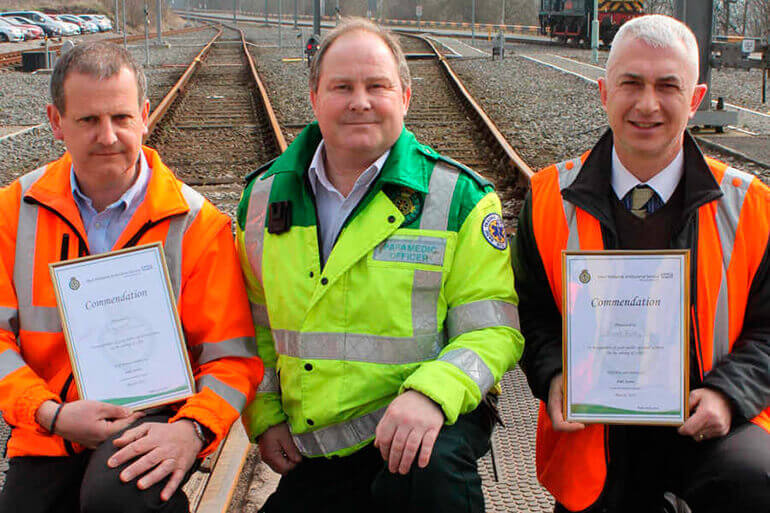
    Lifesavers – Andy Wall and Russell Rowley receive awards from Andy Jeynes

    A trio of workers from a train maintenance firm have been praised for saving the life of a colleague.

    Andy Wall, Barry Parkes and Russell Rowley, who all work at Alston, off Jones Road in Wolverhampton, came to to the rescue of an unnamed contractor who suffered a cardiac arrest.

    Mr Wall, a senior production manager, said: “We were sitting in the office when one of our staff members ran in to tell us that a colleague had collapsed.

    I went round and saw him on the floor gasping for breath. Russell and Barry quickly joined me and as they assessed him, I went to call 999.”

    Mr Parkes, 49, is one of the members of the train maintenance teams and has worked for Alstom for 14 years.

    Like many other staff, he is a trained First Aider.

    Mr Rowley, 42 and a health and safety manager, had only worked at the firm’s Traincare centre for a week.

    He said: “Being my first week at the company I didn’t really know many people and didn’t know Barry, Andy or the gentleman who had collapsed very well.

    But nevertheless, whilst Barry stayed with him, I ran to get the defibrillator from the office.

    When I came back, he had stopped breathing.

    As he’d collapsed in an awkward position by a table and some chairs, Barry and I had to quickly pull him clear so that I could start CPR. Whilst I did CPR Barry opened up the defibrillator to get it ready. No sooner had we started CPR than we were joined by a paramedic who told us to keep doing resuscitation whilst he got his medical equipment out.”

    The paramedic shocked the man’s heart on scene and, thanks to the efforts of the trio, the man started to breathe for himself.

    He was taken to New Cross Hospital for emergency treatment and has since made a full recovery.

    Andy Jeynes, a community response manager from West Midlands Ambulance Service, recently visited Alstom to present commendations to recognise the staff members fantastic achievement.

    “The actions of Andy, Russell and Barry are extremely commendable as saving a life is the best gift you can give,” he said.

    This case just shows how important early CPR is when someone is in cardiac arrest. If it hadn’t been for their decisive actions, the outcome would’ve almost certainly been less positive.

    The quicker you start CPR and shock a patient in cardiac arrest with a defibrillator, the better the chances they have of surviving.”

    Editorial and photograph courtesy of West Midlands Express & Star

  • UK Government Announce Compulsory First Aid for Nursery Recruits

    UK Government Announce Compulsory First Aid for Nursery Recruits

    New nursery and pre-school staff will be required to undertake paediatric first aid for the first time, thanks to new government proposals.

    The plans have received the support of parents Joanne and Dan Thompson, who have been campaigning for the change following the tragic death of their daughter, Millie, at nursery in October 2012. Their important campaign culminated in an e-petition signed by over 103,000 people.

    The new proposals will mean newly qualified staff with a childcare level 2 and 3 qualification must have an emergency paediatric first aid or full paediatric first aid certificate – a life-saving change that will add approximately 15,000 additional trained early years professionals to our nurseries and pre-schools each and every year.

    Mr and Mrs Thompson have also given their backing to the creation of a new special certificate – to be known as ‘Millie’s Mark’ – to be displayed by nurseries who have achieved gold-standard provision. The certificate will help to give parents assurance that their child is being cared for by safe and knowledgeable staff. It is hoped that over time the 2 initiatives announced today will help ensure that as many staff members as possible are trained in these important, life-saving skills.

    Childcare and Education Minister, Sam Gyimah said:

    As a parent myself, I know that every single mum and dad wants the confidence that those tasked with caring for their child have the right training should the absolute worst happen.

    Today’s proposals will mean that thousands more staff will be able to respond to emergencies more quickly, making sure parents really can access the very best possible childcare choices for their families.

    Not only will this help ensure children are safe while they learn, grow and develop, but it will also raise the quality and skills of the early years workforce to help them deal with day-to-day first aid issues, such as allergies and knowing when to call parents.”

    Joanne and Dan Thompson said:

    We are both extremely pleased that the government have listened to our awareness campaign, and changes are being made that could ultimately save a child’s life.

    We are proud that these changes are being made in memory of our precious daughter and that her legacy continues to grow – but we are heartbroken that these changes are only coming into place because we lost her.

    The estimate of 15,000 new childcare workers entering the workplace with this specific qualification is fantastic news for parents and we fully support ‘Millie’s Mark’, and are looking forward to working with the specific government departments to help turn this into a reality.”

    The government has also announced today (12 March 2015) that it is extending a special deal enabling schools to buy life-saving defibrillator machines at reduced prices to all early years settings, including holiday and out-of-school providers.

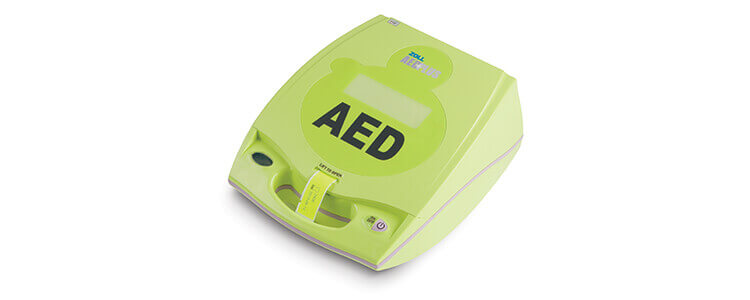
    Defibrillators are easy-to-use machines that could mean the difference between life and death for a child suffering from cardiac arrest. The machines work by delivering a controlled electric shock to the heart through sticky pads placed on the chest. The shocks interrupt the irregular heart rhythm that characterises a cardiac arrest, causing it to return to normal.

    Original source: www.gov.uk

  • Safe Working in Confined Spaces

    Safe Working in Confined Spaces

    Confined Spaces Regulations 1997. Approved Code of Practice, Regulations and guidance.

    This Approved Code of Practice (ACOP) and guidance is for those involved in work within confined spaces, those who employ or train such people and those that represent them.

    It explains the definition of a confined space in the Regulations and gives examples. It will help you assess the risk of working within a particular confined space and put precautions in place for work to be carried out safely.

    This edition brings the document up to date with regulatory and other changes. The guidance has been simplified to make the understanding and use of the document easier, particularly with clarifying the definition of a confined space.

    Download the HSE document to read more: Safe work in confined spaces

    Other changes include:

    • a flowchart to help in the decision-making process
    • additional examples including new workplace risks such as specifically created hypoxic environments, fire suppression systems etc
    • amendments relating to the need to check, examine and test equipment
  • New Allergen Rules for the Food Industry

    New Allergen Rules for the Food Industry

    New Allergen rules have come out this month regarding Food Allergen Labelling for the Food Industry which may be of interest to trainers delivering Food Safety and/or Good Nutrition.

    Detailed information about the rules can be found at: http://www.food.gov.uk/news-updates/campaigns/allergen-rules

    In brief:

    If you are a consumer

    The new allergen information rules will mean that:

    • You can now ask for information about 14 allergens, if used as an ingredient in the food you are buying, when you eat out.
    • You will see allergenic ingredients emphasised (for example, using bold, italics or colours) on prepacked foods. This means all allergen information will be found on the ingredients list only.

    If you are a food business selling loose food or in food service (for example school canteens, cafes, restaurants, takeaways, caterers)

    The new allergen information rules will mean that:

    • You must provide information about 14 allergens, if used as an ingredient in the food you are providing or selling. You can do this on a menu, chalkboard, website or orally, but must signpost your customers to this information.

    If you are a food business manufacturing prepacked food

    The new allergen information rules will mean that:

    • You will have to emphasise allergenic ingredients (for example, by using bold, italics or colours) on the ingredients list. This means all allergen information will be provided on the ingredients list only.
  • October 2015 Ofqual and SQA regulations

    October 2015 Ofqual and SQA regulations

    You may be aware, there are changes in regulations coming into force on 1st October 2015.

    To clarify the situation, in order to continue teaching ofqual and SQA regulated First Aid qualifications, an Instructor must have:

    A teaching qualification at Level 3 or above and
    An Assessing qualification or have attended First Aid Assessor/IQA CPD Training with an Awarding Organisation

    Please note that some teaching qualifications have an assessors element that is suitable, as part of its syllabus. Please see below for the list of acceptable qualifications. All Instructors will need to hold qualifications that tick both the ‘Train’ and ‘Assess’ columns on this document. As you can see, some qualifications tick both boxes. If you only hold a ‘Train’ qualification, then you will need to gain an assessing qualification or attend First Aid Assessor/IQA CPD Training with an Awarding Organisation by October 2015. Please also note that the Level 3 PTLLS qualification holds 6 credits and does not meet the assessors criteria; only the Level 4 PTLLS meets the criteria for assessing.

    In order to monitor fellow Instructors, you must have:

    An Internal Quality Assurance qualification or have attended Internal Quality Assurance CPD Training with an Awarding Organisation

    In order to undertake Internal Verification, you must have:

    An Internal Quality Assurance qualification or have attended Internal Quality Assurance CPD Training with an Awarding Organisation

    Please see the list of acceptable qualifications in the following document: SfH-Assessment-Principles-for-First-Aid-Qualifications-V4

  • CPR and AED training is fast becoming a necessity

    CPR and AED training is fast becoming a necessity

    Nuco Training not only offer dedicated CPR and AED training courses but also the new 4 hour Basic Life Support and Safe use of an AED course.

    A recent UK Government report states …

    It is estimated that around 60,000 out-of-hospital cardiac arrests occur each year in the UK. Overall survival rates vary across England, but range between 2% and 12%. However, survival rates as high as 75% have been reported where CPR and defibrillation are delivered promptly. This is why the statutory guidance on supporting pupils at school with medical conditions advises schools to consider purchasing an AED as part of their first-aid equipment.”

    To see the full document and validation go to www.gov.uk

  • Nuco Training in Saudi Arabia

    When Nuco Training was offered the chance to travel to Saudi Arabia to train 12 new Nuco First Aid Instructors for BAE Systems we jumped at the chance.

    Our Training Manager, Darren Coombs, packed his suitcase and set off on a 19 hour journey. During his time training out there he documented his experiences…

    Arrived safely at Manchester Airport, all checked in and patiently waiting for my gate. Really excited about the challenges that lay ahead. New organisation (World Wide presence), new learner’s and a whole new environment to explore…

    After a long journey yesterday, all 19 hours of it….. I’m here, safe and sound. Here’s a summary of the journey. Late leaving Manchester by 20 mins, which mean’t i had to move quickly through Amsterdam to catch my connecting flight to Damman. Took off from Amsterdam for a scheduled stop in Kuwait, which I wasn’t aware of… Non the less, a scheduled stop that was only supposed to take 45 mins, turned into 1:15 mins as we had an unwanted passenger that the airline had to remove… Finally landed at KFI Airport at 00:40 4th October. I was then met by Graham Nicholson and Mark Maguire-Ware of BAE Systems Saudi Arabia Limited and taken to the compound somewhere about 45mins away from KFI. I was shown to my villa where I will be staying for the duration and have just finished a guided tour around the complex, thanks to Graham Nicholson. Once last thing… The temp here is 45 degrees and also when i landed last night it was 33 degrees. Shorts and shades weather.

    Ok… So a good day’s work. Started with an early to rise, went to the sports complex and smashed a good sweat session in the ‘house of pain’. Checked my e-mails, light lunch, ironed my shirts as they had got creased in the suit case and then went to the visitors centre to set up the classroom/learning environment for the remaining 4 days. A quick call to the office, as I needed some admin support. As always they were more than happy to help! Had tea in the ‘Bowl’ with Graham Nicholson this evening followed by a catch up with my family on Skype and now about ready to turn in… I am ready to face the challenges ahead tomorrow, a new group with new opinion’s. That’s what this job is all about.

    Day 1 – What a superb day! … BAE Systems Saudi Arabia Lmited really know how to look after their guests. The day started with an early to rise, followed by some b/fast and then a nice early morning walk (06:50 hrs) to the compound where I was teaching for the day. Arrived glowing, as you can imagine and proceeded to set up the remaining props/resources prior to the arrival of the group. Shortly after, Saudi Catering arrived to provide the refreshments for the day… When I say the day, I mean there was a chap that remained there all day to wait on us. Food was outstanding, and equally the venue was more than appropriate. Day 1 – The teaching/scheduled day started at 08:00hrs as planned yesterday and started with the intro, followed by the Introductory paper. Constructive and points rose from the paper as we treated it as a form of recap. All welcomed the delivery, effective teaching points were raised. Good group work, discussions and feedback on the ‘Instructional Techniques’, as they say… Everyday is a school day! (Interesting fact – Keith Williams has just paid his 50th speeding fine in the Kingdom. All you do here, is pay the fine and that’s it, done and dusted.) Had lunch and began to listen to the micro teaching sessions. As always some very good trainers, good idea’s and certainly plenty of energy. A mixed group coming from different social backgrounds which has made the day both informative and creative, most of all overflowing with fresh idea’s. Everyone has left for the day, with their evening work to do postive and ready for another day. Tomorrow is another day, with new challenges.

    Day 2 – Another massive thanks to BAE Systems Limited and Saudi Catering Limited for all their hospitality today, amazing! Oh not forgetting Saleh, Turky, Abdul, Wafi, Mark, Graham, Andy, Steve, Keith, Simon, Kevin and Paul for all their hard work and effort. It’s worth mentioning that Wafi did the whole day with ‘Man Flu’, now as First Aiders we certainly know how dabilitating that can be. So, a productive morning covering Scheme’s of Work and Session Plans, followed by the assessment process, valued discussions were had and some positive issues were raised. The session’s have been set for tomorrow and so the group have gone their ways to prepare for yet another vibrant day at Al Khobar, KSA. Interesting fact all the way from Saudi Arabia – If you gently place a sock over a cat’s head, it will walk backwards. Some more interesting facts to follow tomorrow.

    Day 3 – Must apologise for not updating this status on Monday evening, that said though I have a very good excuse! When the training finished Graham Nicholson and Mark Maguire took me into Al Khobar to sample the local delights. To that end, I witnessed the highway code in Saudi Arabia, the busy streets, the shopping Mals and the abundance of watch shops! I must say, in absolute heaven. Anyone who knows me will know that I like a watch… I mustn’t forget meeting Abdullah for a cheeky burger along with Graham and Mark also Monday evening. I must confess though, Abdullah did have a cheeky ceasers salad instead of a heart attack in a bun!! Back to the update on the training – Day 3 went exceptionally well with all the trainers delivering their summative sessions and giving constructive feedback to their peers. There was also an opportunity for Turky Fagihi to show off his good side, and also plenty of chances for the trainers to shine. Which of course they did indeed. Lunch was served by Saudi Catering Company as they had been doing so during the course, and as always the standard of service was outstanding (hungry now, thinking about it). A good discussion was had relative to nuco plus and how the system will work for the trainers before, during and after their courses. The site was welcomed as always. The day ended as well as you would expect. All the trainers left on a positive note, energised and ready for the final day.

    Day 4 – After sampling the delights of down-town Al Khobar and suffering the morning temps of 33 (celsius) at 06:50 am, I arrived somewhat damp at the training venue. Once everyone had arrived we proceeded to complete the final case study for the PTLLS element of the course, followed closely by recapping on the assessment protocols. This went extremely well, and highlighted issues that could be presented during such a process. No sooner had we completed the above we then proceeded to begin with the task of piecing together the PTLLS portfolio in preparation for internal verification. With a brief pause for lunch we proceeded to complete the build in time for a debrief, wash-up and the trainers to evaluate the course content, structure, venue, resources and of course the tutor. I’m guessing you know the outcome! Yeah that’s it, good constructive feedback. Ummmmmm a group photo! – Please see above. Once finished I was dragged into Al Khobar again to do a spot of panic shopping prior to going home that evening. There wasn’t any kicking and screaming at all!! Again the saviour Mark Maguire-Ware delivered me safely to KFI Airport, where I joined my flight with KLM to Amsterdam, waited for my connecting flight to Manchester. 14 hours later I have now arrived home safe and sound. In summary – What a fantastic course, made to feel extremely welcome by Graham, Mark, Wafi, Abdullah, Turky, Saleh, Paul, Kevin, Simon, Keith, Steve and not forgetting Andy. A big thank you to Wafi for the traditional head garment that he obtained for me. It will be a reminder of my time delivering a great course, with great trainers in a great country. Also, a big thank you to Saleh for translating Nuco into Arabic.”

    nuco in arabic

    [distance1]

  • Schools Able to Hold a Stock of Emergency Inhalers

    Schools Able to Hold a Stock of Emergency Inhalers

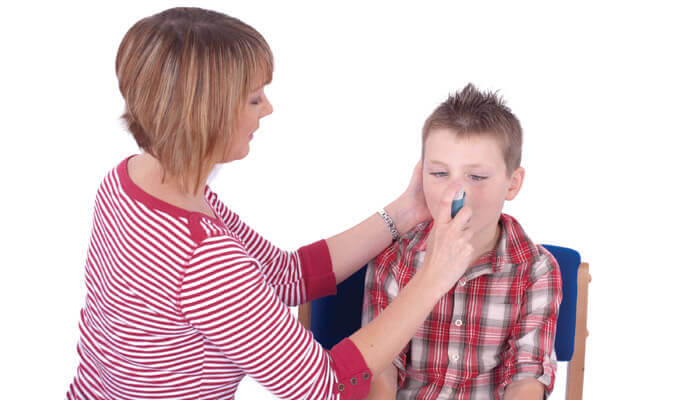
    From the 1st October 2014 schools are now able to hold Salbutamol Inhalers for emergencies.

    Approximately 20 children of school age in England and Wales die every year from asthma and most deaths occur before the child reaches hospital. A survey from Asthma UK found that 64% of children with asthma have at some point been unable to access a working reliever inhaler in school, having either forgotten, lost, broken or run out of their own. 62% of children with asthma have had an asthma attack while at school.

    In 2012, Asthma UK made enquiries as to whether the law could be changed to allow schools to keep a spare reliever inhaler for use in an emergency. Some schools had already implemented protocols for holding and using inhalers in an emergency, although not permitted by the legislation.

    The Department of Health (DH) then consulted with the Department for Education (DfE) and interviewed teachers and parents to ascertain their feelings on the subject. Staff and parents were almost unanimously in favour of schools being allowed to hold an inhaler for emergency use.

    An evaluation of risks and benefits of schools holding a Salbutamol Inhaler for emergency use was submitted to the Commission on Human Medicines (CHM). The CHM then recommended that the legislation should be amended based on the risks and benefits.

    The amendment affects the Human Medicines Regulations 2012, to allow schools to hold stocks of asthma inhalers containing salbutamol for use in an emergency. The amended regulations came into effect on 1st October 2014. From this date onwards, schools can buy inhalers and spacers (the plastic funnels which make it easier to deliver asthma medicine to the lungs) from a pharmaceutical supplier in small quantities provided it is done on an occasional basis and is not for profit.

    Please Click Here to view the full report from the Department of Health and details on what a school must do in order to be able to hold Salbutamol Inhalers for emergencies.

    Details of the change in policy for Schools allowing them to hold spare inhalers change can be found on the Government website.

    There is also a download sheet on that link that outlines the full details of the consultation on this topic, along with requirements for Schools who wish to hold them.

  • Level 3 Paediatric Qualification

    Level 3 Paediatric Qualification

    The existing 2-day Level 2 Paediatric qualification is to become a Level 3 qualification (Level 6 in Scotland).

    In addition, we have just received confirmation that Ofqual have accepted our request for a new Level 3 Award in Emergency Paediatric First Aid (QCF) which will be a new regulated qualification on 1st September.

    As from 1st September 2014:

    The 1-day course is now entitled:

    Level 3 Award in Emergency Paediatric First Aid (Level 6 in Scotland)

    The 2-day course is now entitled:

    Level 3 Award in Paediatric First Aid (Level 6 in Scotland)

    Both of these new qualifications still consist of the same course content as the previous qualifications, so the 1-day and 2-courses can be run in exactly the same way using the existing notes, PowerPoint and manuals.

    The main advantage is that the 2-day course has been re-levelled from Level 2 in England, Wales and Northern Ireland to Level 3 and from Level 5 to Level 6 in Scotland.

    The 1-day course now offers the learners a Level 3 Emergency Paediatric First Aid qualification (Level 6 in Scotland) rather than being a unit accredited course as previously.

    There is a new training aid book for the new Paediatric First Aid course available from our online shop. The new book will support the full 2-day Paediatric First Aid course and it will also include a section on AED and adult BLS.

    It is possible that the 2-day course may become a 3-day course next year. We have to wait to see what changes will be made to the syllabus and will keep you posted on this development. The Awarding Organisations and regulatory bodies are meeting in November to discuss this, and we will have an update on this immediately after.